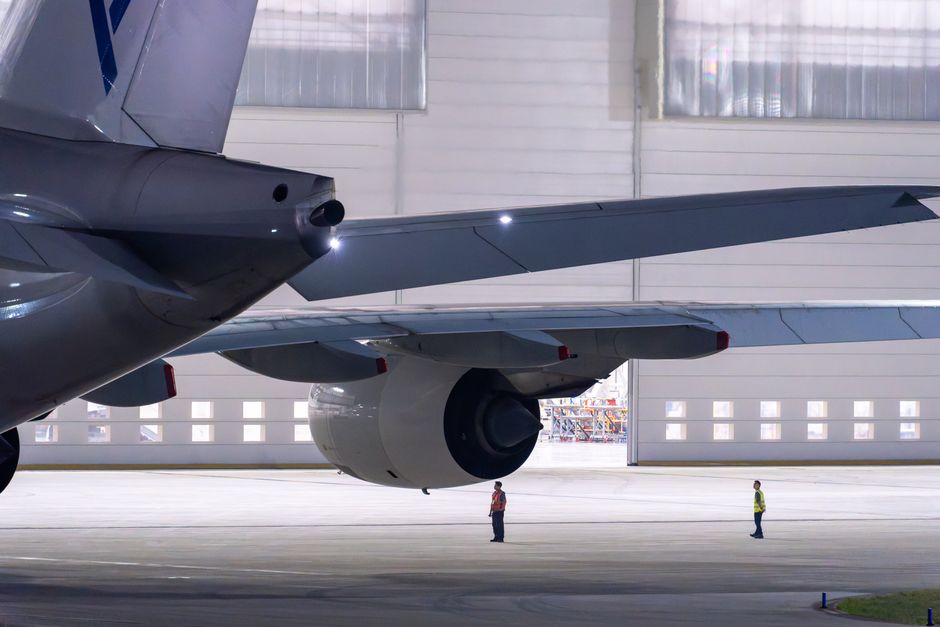
An aviation maintenance technician is the FAA-certificated mechanic who inspects, repairs, and signs off the aircraft you fly on — and it is one of the few well-paid technical careers you can enter in about two years without a bachelor’s degree. According to the Bureau of Labor Statistics, aircraft mechanics and service technicians earned a median annual wage of $78,680 in May 2024, with avionics technicians at $81,390.
- What an aviation maintenance technician actually does
- The two paths to becoming an aviation maintenance technician
- What aviation maintenance technician school costs and how to pay for it
- The tests that make you a certificated aviation maintenance technician
- Aviation maintenance technician pay and job outlook
- What most people get wrong
- How to start this month
- Frequently Asked Questions
Here is the short version of how you get there. You either graduate from an FAA-approved Part 147 Aviation Maintenance Technician School, or you document real hands-on maintenance experience under 14 CFR 65.77 — at least 18 months for a single rating, or at least 30 months working on both airframes and powerplants. Either route ends at the same place: FAA written, oral, and practical tests.
Pass those tests and the FAA issues your mechanic certificate with Airframe and Powerplant ratings — the “A&P.” This guide walks through what an aviation maintenance technician does day to day, what school costs and how financial aid works, exactly what the tests involve, what the pay data actually says, and the mistakes that cost people time and money.
What an aviation maintenance technician actually does
An aviation maintenance technician keeps aircraft airworthy. That means scheduled inspections, troubleshooting systems that are misbehaving, replacing components, repairing structures, and — critically — making the logbook entry that returns the aircraft to service. That signature is a legal act. It is why the FAA certificates you personally, not just your employer.
The work splits roughly along the ratings. Airframe covers structure, hydraulics, landing gear, flight controls, and environmental systems. Powerplant covers reciprocating and turbine engines, propellers, fuel, and ignition. Avionics technicians, which BLS tracks separately, focus on navigation, communication, and electronic flight instrument systems.
Expect hangars, flight lines, and shift work. Airline heavy maintenance often runs overnight, because that is when aircraft are on the ground. BLS reports that most aircraft mechanics work full time and that overtime is common. Aviation maintenance technician work is physical and hands-on — if you like diagnosing real systems and want your work to matter measurably, it fits.
The two paths to becoming an aviation maintenance technician
The FAA recognizes two doors. Under 14 CFR 65.71, you must be at least 18 years old and able to read, write, speak, and understand English (with a limited exception, endorsed “valid only outside the United States,” for mechanics employed abroad by U.S. air carriers). Then you show eligibility one of two ways.
| Factor | Part 147 school | Documented experience |
|---|---|---|
| What proves eligibility | Certificate of completion from an FAA-approved AMTS | Documentary evidence accepted by an FAA inspector |
| Time required | Commonly 18–24 months full time (varies by school) | 18 months for one rating; 30 months for both, per 14 CFR 65.77 |
| Cost to you | Tuition, fees, tools | Usually none — you are being paid |
| Federal aid eligible | Often yes, if the school participates in Title IV | No |
| Main risk | Debt if you do not finish | Finding an employer who will hire and document you |
Most people become an aviation maintenance technician through the school route, because it is structured and finite. The experience route is fully legal, but it depends on finding a repair station, general aviation shop, or military job that gives you documented, supervised time on the right tasks. Military maintenance experience frequently counts; the Joint Service Aviation Maintenance Technician Certification Council program helps service members map their records to FAA ratings.
One update worth knowing: the FAA rewrote Part 147 in 2022, moving from a fixed curriculum-hours model to Airman Certification Standards. The old “1,900 hours” figure still describes many programs, but it is no longer a federal minimum. Ask any school directly how long its program runs and what its graduates’ certification pass rate is.
What aviation maintenance technician school costs and how to pay for it
Tuition varies enormously. A community college Part 147 program can cost a fraction of what a private aviation academy charges, and that gap is the single biggest financial decision you will make. Never assume an advertised price includes tools, books, testing fees, or the FAA exams. Ask for the full cost of attendance in writing before you sign anything.
Federal aid can apply. Federal Student Aid states that Pell Grant funds can be used at eligible community colleges, career schools, and trade schools — not only four-year universities. The maximum Pell Grant award is $7,395 for both the 2025–26 and 2026–27 award years, and what you actually receive depends on your Student Aid Index, your cost of attendance, and your enrollment status.
File the FAFSA at studentaid.gov even if you assume you will not qualify — it is also the gateway to federal loans, state grants, and many institutional awards. Important caveat: whether a specific aviation maintenance technician program is Title IV eligible depends on that school’s accreditation and participation. Some Part 147 schools accept federal aid; some do not. Confirm with the school’s financial aid office before enrolling.
Satisfactory academic progress rules, disbursement timing, and how aid applies to certificate versus degree programs are set school by school within federal minimums, so your financial aid office is the only reliable source for your situation. Also ask about employer sponsorship — several airlines and MRO companies now fund students or reimburse tuition — and check your state’s workforce agency for training grants, which vary by state.
The tests that make you a certificated aviation maintenance technician
Certification happens in two stages. First, three FAA computer-based knowledge tests: General, Airframe, and Powerplant. Your Airman Knowledge Test Report is valid for 24 calendar months, so you cannot pass General and then drift for three years before finishing the rest.
Second come the oral and practical exams, administered by a Designated Mechanic Examiner. The DME questions you and watches you perform tasks drawn from the FAA’s Aviation Mechanic Airman Certification Standards. FAA guidance requires all prescribed tests to be passed within a 24-month period. DMEs set their own fees, so ask about cost up front and budget separately for retests. No school or examiner can promise you a pass.
A licensing point worth stating precisely: the A&P mechanic certificate is federal, issued by the FAA, and is valid in all 50 states. But other credentials an aviation maintenance technician may pick up — welding certifications, state contractor rules for certain ground work, and state-level school licensing or tuition-refund rules — do vary by state. Check your state licensing board or higher-education agency rather than assuming a national rule.
Aviation maintenance technician pay and job outlook
Here is what the federal data says. According to BLS, the median annual wage for aircraft mechanics and service technicians was $78,680 in May 2024; the lowest 10 percent earned less than $47,790 and the highest 10 percent earned more than $120,080. For avionics technicians, BLS reports a median of $81,390, with the top 10 percent above $113,580.
🎓 Get Free Scholarship Alerts
Free · No spam · Unsubscribe anytime
On outlook, BLS projects employment of aircraft and avionics equipment mechanics and technicians to grow 5 percent from 2024 to 2034 — faster than the average for all occupations — with about 13,100 openings projected each year on average over the decade. Most of those openings come from replacing workers who retire or move on. That is a steady market for new aviation maintenance technician graduates, not a guaranteed one.
Read the numbers honestly. A median is the middle of the field, not a starting salary. A new aviation maintenance technician at a small general aviation shop will likely start well below it, while a technician with several years at a major airline, on a union contract, working nights, can sit near the top. Geography, employer type, and shift differential drive most of that spread.
What most people get wrong
Three mistakes come up over and over.
- Treating the median as a starting wage. It is not. Plan your first two years around a realistic entry-level number for your region, then let experience and ratings move you up.
- Enrolling before checking Title IV status and pass rates. A program that cannot accept federal aid, or whose graduates struggle on the FAA exams, costs you far more than its tuition line.
- Underestimating tools. Many employers expect an aviation maintenance technician to own a substantial personal tool set. Ask what the employer supplies before you assume.
Two smaller ones. People confuse the A&P certificate with an Inspection Authorization — the IA is a separate FAA authorization requiring additional experience while holding your A&P. And people assume a degree is required. It is not: BLS lists a postsecondary nondegree award as the typical entry-level education, and the FAA cares about your certificate, not your diploma.
How to start this month
You do not need a ten-year plan. You need the next three steps.
- Use the FAA’s official list of approved Aircraft Maintenance Technician Schools at faa.gov to find every program within commuting distance, then compare total cost, length, and graduate certification pass rates.
- File the FAFSA at studentaid.gov, then ask each school’s financial aid office directly whether that specific aviation maintenance technician program is federal-aid eligible and what their SAP rules are.
- Visit a working hangar. Call a local repair station or FBO and ask to talk with a mechanic for twenty minutes — the cheapest possible way to learn whether the daily reality of being an aviation maintenance technician actually suits you.
If school is not financially realistic right now, look for an entry-level job — line service, parts, tool crib — at a repair station, and ask explicitly whether they support employees documenting experience toward the FAA’s 30-month path. Nobody is obligated to say yes. Asking early is still how a lot of people get in.
Frequently Asked Questions
How long does it take to become an aviation maintenance technician?
Through an FAA-approved Part 147 school, programs commonly run about 18 to 24 months full time, though length varies by school since the FAA moved Part 147 to a standards-based model in 2022. Through documented work experience, 14 CFR 65.77 requires at least 18 months for a single rating or at least 30 months for both.
Do I need a college degree?
No. BLS lists a postsecondary nondegree award as the typical entry-level education for this field, and the FAA issues the mechanic certificate based on approved training or documented experience plus passing the tests. Some technicians later add a degree for management or engineering roles, but it is not required to hold an A&P.
Is the A&P certificate valid in every state?
The FAA mechanic certificate is a federal credential and is recognized nationwide. Any additional state-level requirements — for related trades, school licensing, or specific employers — vary by state, so check your state’s licensing board or higher-education agency instead of relying on a figure you found online.
Can I get financial aid for a Part 147 program?
Often, but not always. Federal Student Aid says Pell Grant funds can be used at eligible career and trade schools, with a maximum award of $7,395 for 2025–26 and 2026–27. Eligibility depends on the school’s Title IV participation and your own FAFSA results, so confirm with that school’s financial aid office.
Ready to find money for school?
Find Money Where You Live
Scholarship and grant programs change from state to state, and many of the biggest awards come from your own state’s aid programs. Pick your state to see the scholarships that apply where you live.
See Scholarships in All 50 States →
Sources & How to Verify
The facts on this page are drawn from official government and primary sources. Rules, figures, and program details change, so always confirm the current details with the official agency, your school’s financial aid office, or the program’s own published rules.
- Federal Student Aid: studentaid.gov — the official source for FAFSA, grants, work-study, and aid rules
- FTC Consumer Advice: consumer.ftc.gov — scholarship and financial aid scam guidance
- IRS: irs.gov — how scholarships and fellowships are treated for taxes
- Bureau of Labor Statistics: bls.gov/ooh — official wage and job-outlook data for every career
- Your school’s financial aid office: aid rules vary by school — for your specific situation, their answer is the one that counts
Content last reviewed August 2026. If you notice outdated information, please contact us.
Related Guides
- Scholarships by State (50-State Guide)
- More in This Category
- Scholarship Scam Checks
- College Survival Guide
- All Scholarship Resources
- Browse All Scholarships
Informational only — not legal, tax, financial, or academic advice. Spot Scholarships is an independent educational resource. Financial aid rules, scholarship terms, school policies, and licensing requirements vary by school, program, and state and change over time, so always verify the current details with your school’s financial aid office, the official agency, or the program’s published rules before acting. Nothing on this page guarantees admission, aid, or an award.