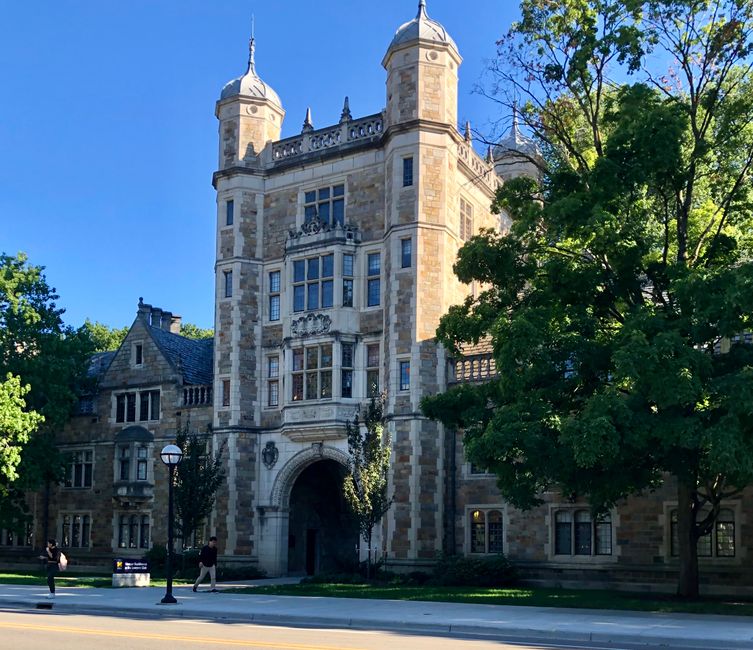
Michigan Colleges come in more shapes than the rankings sites let on: 71 degree-granting colleges, of which 29 are open admission (no one is turned away) and 41 more do not require test scores. The lowest real net price in the state is West Shore Community College at about $1,527 a year – net price, not the sticker. Every number on this page is federal College Scorecard data – not marketing, not a paid ranking.
Michigan Colleges at a Glance
- Degree-granting colleges: 71 (of 149 Scorecard institutions incl. trade schools)
- Open admission (everyone gets in): 29
- Test scores not required: 41 more
- Public community colleges: 32
- Four-year colleges: 44
On this page
What Paying for Michigan Colleges Actually Looks Like
There are 149 operating colleges in Michigan, which is a bigger number than most families expect. That count includes large universities, small private schools, community colleges, and specialized institutions, so the word “college” covers a lot of very different places. The useful thing to know early is that michigan colleges are not one pool you get sorted into. They are separate schools with separate rules, separate prices, and separate ideas about who they are looking for, and a student who is not a fit at one may be a strong fit at another.
Admission works differently across michigan colleges than the national conversation suggests. Of the 149, 29 are open-admission, meaning no applicant is turned away. Another useful figure is that 41 do not require test scores at all. If your student has had a rough semester, or never loved standardized tests, or is coming back to school after time away, those numbers are worth sitting with. They do not mean everything is easy, and they do not mean a particular student will be admitted anywhere in particular, but they do mean the door is open in more places than the anxiety around applications implies.
Community colleges are a large part of this picture. Michigan has 32 public community colleges, and they tend to be the least expensive route into higher education, often with transfer agreements that let credits move on to a four-year school later. The lowest average net price on this page belongs to West Shore Community College, at about $1,527 per year. That is an average across the students who attend, not a quoted bill, so your family’s actual cost could land above or below it depending on income, aid, residency, and program. Treat it as a signal that low-cost options exist, then check the specific school’s own net price calculator for your own situation.
At the other end of the scale, Michigan State University is the largest four-year college in the state. Size brings real advantages, like a wide range of majors, research, and a big alumni network, and it also brings tradeoffs, like bigger classes and more responsibility on the student to seek things out. Neither big nor small is better in the abstract. Some students bloom in a place with a thousand things happening; others need faculty who know their name by October. That is a family conversation, not a ranking question.
The honest summary is that michigan colleges give you room to choose, and that the numbers on this page are a starting point rather than an answer. No page, including this one, can tell you whether a student will be admitted or what aid they will receive. Only the college can do that, and only after they see the actual application and financial information. So use the data here to build a short list of michigan colleges worth a closer look, then go to each school’s own admissions and cost pages, call the financial aid office with your questions, and visit if you possibly can. The schools that answer your questions clearly are telling you something useful about themselves.
Michigan Colleges With Open Admission
Open admission means exactly what it sounds like: meet the basic requirements (usually a diploma or GED) and you are in. No essays sweated over, no rejection letter. These michigan colleges are where the “will I get in anywhere?” worry ends – and several lead to the same careers as far more selective schools.
| College | City | Type | Avg net price/yr | Grad rate |
| Macomb Community College | Warren | Public 2-year | $1,618 | 17% |
| Oakland Community College | Auburn Hills | Public 2-year | $5,777 | 32% |
| Grand Rapids Community College | Grand Rapids | Public 2-year | $8,621 | 24% |
| Lansing Community College | Lansing | Public 2-year | $5,437 | 19% |
| Schoolcraft Community College District | Livonia | Public 2-year | $2,260 | 21% |
| Wayne County Community College District | Detroit | Public 2-year | $7,656 | 20% |
| Delta College | University Center | Public 2-year | $4,547 | 24% |
| Mott Community College | Flint | Public 2-year | $5,687 | 21% |
| Kalamazoo Valley Community College | Kalamazoo | Public 2-year | $2,979 | 21% |
| Kellogg Community College | Battle Creek | Public 2-year | $4,858 | 15% |
| Northwestern Michigan College | Traverse City | Public 2-year | $6,231 | 32% |
| Muskegon Community College | Muskegon | Public 2-year | $4,005 | 21% |
| St Clair County Community College | Port Huron | Public 2-year | $5,571 | 31% |
| Lake Michigan College | Benton Harbor | Public 2-year | $6,680 | 23% |
| Mid Michigan College | Harrison | Public 2-year | $8,370 | 23% |
14 more open-admission colleges omitted for length – the Scorecard link at the bottom lists every one.
Test-Optional Michigan Colleges
These schools do not require SAT or ACT scores. That does not make them easy – grades and coursework still matter – but a bad test day will not close the door. Combined with the open-admission list above, most michigan colleges are reachable without a test score.
| College | City | Admission rate | Avg net price/yr |
| Michigan State University | East Lansing | 85% | $19,680 |
| University of Michigan-Ann Arbor | Ann Arbor | 16% | $13,138 |
| Grand Valley State University | Allendale | 83% | $16,317 |
| Wayne State University | Detroit | 81% | $12,766 |
| Western Michigan University | Kalamazoo | 85% | $15,273 |
| Oakland University | Rochester Hills | 88% | $9,120 |
| Eastern Michigan University | Ypsilanti | 80% | $15,407 |
| Central Michigan University | Mount Pleasant | 90% | $17,597 |
| Ferris State University | Big Rapids | 91% | $8,624 |
| Northern Michigan University | Marquette | 84% | $14,085 |
| Saginaw Valley State University | University Center | 72% | $10,775 |
| Michigan Technological University | Houghton | 92% | $14,182 |
| University of Michigan-Dearborn | Dearborn | 56% | $9,492 |
| University of Michigan-Flint | Flint | 70% | $7,007 |
| Hope College | Holland | 79% | $27,182 |
26 more listed in the full table below.
What about trade and certificate schools? Michigan also has 73 open-admission institutions that award certificates rather than degrees – welding, cosmetology, medical assisting, HVAC and similar. Many are excellent and lead straight to licensed work; many are for-profit, and outcomes vary widely between them. They are kept out of the college tables on this page so the comparison stays apples-to-apples, and covered properly in our trade school guides, where the pay data comes from the Bureau of Labor Statistics.
The Cheapest Michigan Colleges by Real Net Price
Sticker price is a fiction most families never pay. Net price is what students actually paid on average after grants and scholarships – the honest number, straight from the federal data. These are the ten lowest degree-granting colleges in Michigan. For-profit certificate academies often post lower prices than anything here, but they award certificates rather than degrees, so they are covered separately below rather than mixed into this comparison:
| College | City | Type | Avg net price/yr | Grad rate | Median earnings (10 yr) |
| West Shore Community College | Scottville | Public 2-year | $1,527 | 28% | $36,115 |
| Macomb Community College | Warren | Public 2-year | $1,618 | 17% | $41,596 |
| Schoolcraft Community College District | Livonia | Public 2-year | $2,260 | 21% | $42,722 |
| Kalamazoo Valley Community College | Kalamazoo | Public 2-year | $2,979 | 21% | $38,618 |
| Alpena Community College | Alpena | Public 2-year | $3,320 | 50% | $36,442 |
| Muskegon Community College | Muskegon | Public 2-year | $4,005 | 21% | $36,549 |
| Delta College | University Center | Public 2-year | $4,547 | 24% | $37,781 |
| Monroe County Community College | Monroe | Public 2-year | $4,586 | 24% | $41,646 |
| Kellogg Community College | Battle Creek | Public 2-year | $4,858 | 15% | $38,329 |
| Gogebic Community College | Ironwood | Public 2-year | $5,397 | 35% | $40,950 |
Pair any of these with the awards on our Michigan scholarships page and the real cost drops again.
Community Colleges in Michigan
Two years at a community college and a transfer is the cheapest path through the michigan colleges system for most families – same bachelor’s degree at the end, a fraction of the debt. Michigan has 32 public community and technical colleges:
| College | City | Avg net price/yr |
| Macomb Community College | Warren | $1,618 |
| Oakland Community College | Auburn Hills | $5,777 |
| Grand Rapids Community College | Grand Rapids | $8,621 |
| Henry Ford College | Dearborn | $660 |
| Lansing Community College | Lansing | $5,437 |
| Washtenaw Community College | Ann Arbor | $3,249 |
| Schoolcraft Community College District | Livonia | $2,260 |
| Wayne County Community College District | Detroit | $7,656 |
| Delta College | University Center | $4,547 |
| Mott Community College | Flint | $5,687 |
| Kalamazoo Valley Community College | Kalamazoo | $2,979 |
| Jackson College | Jackson | $7,761 |
| Kellogg Community College | Battle Creek | $4,858 |
| Northwestern Michigan College | Traverse City | $6,231 |
| Muskegon Community College | Muskegon | $4,005 |
17 more not shown.
Michigan Colleges Compared: The Four-Year Table
Every four-year college, largest first, with the five numbers that matter: how hard it is to get in, the SAT middle band (25th to 75th percentile of admitted students – below the low number does not mean rejected), the real net price, how many finish, and what graduates earn ten years after starting.
| College | Admit rate | SAT mid-50% | Net price/yr | Grad rate | Earnings (10 yr) |
| Michigan State University | 85% | 1180–1360 | $19,680 | 82% | $67,253 |
| University of Michigan-Ann Arbor | 16% | 1360–1530 | $13,138 | 94% | $83,648 |
| Grand Valley State University | 83% | 940–1190 | $16,317 | 66% | $56,118 |
| Wayne State University | 81% | 1060–1270 | $12,766 | 59% | $53,493 |
| Western Michigan University | 85% | n/a | $15,273 | 61% | $53,562 |
| Oakland University | 88% | 1030–1230 | $9,120 | 61% | $58,612 |
| Eastern Michigan University | 80% | 920–1170 | $15,407 | 54% | $51,793 |
| Central Michigan University | 90% | 960–1200 | $17,597 | 62% | $55,874 |
| Ferris State University | 91% | 890–1120 | $8,624 | 60% | $54,735 |
| Northern Michigan University | 84% | n/a | $14,085 | 56% | $47,107 |
| Saginaw Valley State University | 72% | 920–1170 | $10,775 | 51% | $51,955 |
| Michigan Technological University | 92% | 1130–1350 | $14,182 | 71% | $78,198 |
| University of Michigan-Dearborn | 56% | 990–1255 | $9,492 | 60% | $59,649 |
| University of Michigan-Flint | 70% | 970–1243 | $7,007 | 50% | $53,230 |
| Hope College | 79% | 1100–1340 | $27,182 | 80% | $58,427 |
| Calvin University | 71% | 1083–1330 | $22,992 | 77% | $58,375 |
| Davenport University | 98% | n/a | $17,707 | 47% | $45,099 |
| Baker College | 82% | 960–1160 | $13,157 | 27% | $35,833 |
| University of Detroit Mercy | 75% | 1030–1260 | $15,232 | 68% | $71,030 |
| Northwood University | 65% | n/a | $27,232 | 67% | $63,075 |
| Lawrence Technological University | 56% | n/a | $32,918 | 61% | $69,151 |
| Madonna University | 63% | 880–1080 | $17,755 | 61% | $59,058 |
| Adrian College | 73% | 873–1140 | $25,368 | 52% | $55,504 |
| Hillsdale College | 21% | 1320–1490 | n/a | 86% | n/a |
| Siena Heights University | 69% | 806–1073 | $17,124 | 71% | $57,529 |
| Lake Superior State University | n/a | n/a | $12,822 | 57% | $49,045 |
| Albion College | 81% | n/a | $14,301 | 63% | $58,799 |
| Cornerstone University | 78% | n/a | $20,301 | 64% | $47,314 |
| College for Creative Studies | 92% | n/a | $34,617 | 61% | $44,860 |
| Andrews University | 82% | 990–1290 | $12,547 | 67% | $53,187 |
| Kettering University | 79% | 1160–1330 | $34,660 | 72% | $94,823 |
| Kalamazoo College | 75% | 1170–1380 | $19,072 | 78% | $65,590 |
| Alma College | 57% | n/a | $20,694 | 63% | $54,742 |
| Aquinas College | 90% | 910–1140 | $16,626 | 62% | $49,584 |
| Spring Arbor University | 52% | 1010–1240 | $19,353 | 60% | $51,732 |
9 smaller four-year colleges omitted for length; the Scorecard link below covers all of them.
🎓 Get Free Scholarship Alerts
Free · No spam · Unsubscribe anytime
What Each of the Michigan Colleges Is Strongest In
The federal data shows what share of each college’s degrees come from each field – so instead of a marketing brochure, here is where each school actually concentrates. A college is listed when at least a quarter of its degrees come from one field:
| College | Focus | Concentration |
| Cleary University | Business-focused | 100% of degrees |
| Northwood University | Business-focused | 87% of degrees |
| Kettering University | Engineering-focused | 81% of degrees |
| Michigan Technological University | Engineering-focused | 56% of degrees |
| Davenport University | Business-focused | 47% of degrees |
| University of Detroit Mercy | Engineering-focused | 45% of degrees |
| Kellogg Community College | Health-focused | 43% of degrees |
| College for Creative Studies | Arts-focused | 41% of degrees |
| Lawrence Technological University | Engineering-focused | 39% of degrees |
| West Shore Community College | Health-focused | 38% of degrees |
| Baker College | Health-focused | 37% of degrees |
| Gogebic Community College | Health-focused | 37% of degrees |
| Lansing Community College | Health-focused | 34% of degrees |
| Muskegon Community College | Health-focused | 32% of degrees |
| Concordia University Ann Arbor | Business-focused | 32% of degrees |
Common Questions
Which michigan colleges accept everyone?
29 colleges in Michigan are open admission – the first table on this page lists them. A diploma or GED is typically the only academic requirement.
What is the cheapest college in Michigan?
By average net price – what students actually paid – it is West Shore Community College at about $1,527 per year in the current federal data. State grants and outside scholarships can push your own cost below that; see the Michigan scholarships page.
Do michigan colleges require the SAT or ACT?
Not all of them. 41 schools beyond the open-admission list do not require scores. Policies change year to year, so confirm on the college’s own admissions page before you skip the test.
The fastest way to use this michigan colleges guide is backwards: pick the net price your family can live with first, then see which schools fit it.
Bookmark this page – the michigan colleges data refreshes with every annual federal release, so the numbers stay honest instead of aging quietly.
When you compare michigan colleges, weigh the graduation rate as hard as the price: a cheap school you never finish is the most expensive kind.
Most families overestimate what michigan colleges cost, because sticker prices make headlines and net prices do not.
No table can rank michigan colleges for you – the right one depends on your major, your commute, and your budget, and only you know those.
Guidance counselors can pull the same federal numbers behind this michigan colleges page, so bring it to your next meeting and ask what they would add.
Out-of-state readers can compare michigan colleges against their own state’s page – the same six tables exist for all fifty states.
Print the shortlist you build from these michigan colleges tables and take it on campus visits; the numbers make better questions than any brochure.
If a school you expected is missing from these michigan colleges tables, it may be too small for the row caps here – the Scorecard link below has every institution.
Treat this michigan colleges page as the starting map, not the finish line: the college’s own net price calculator is always the final word on your cost.
Ready to cut the price of any college on this page?
Sources & How to Verify
Every figure above comes from the U.S. Department of Education College Scorecard (retrieved August 2026; the Scorecard updates annually and this page is regenerated with each release). Prices are averages – your own net price depends on your family income. Verify any college directly:
- College Scorecard: collegescorecard.ed.gov — look up any school’s current numbers
- Federal Student Aid: studentaid.gov — FAFSA, grants, and aid rules
- The college’s own net price calculator: every school is required to publish one — it is the closest thing to your real number
Related Guides
- Michigan Scholarships (the sibling page)
- Scholarships by State (50-State Guide)
- College Decisions
- College Survival Guide
- Browse All Scholarships
Informational only — not admissions, legal, tax, or financial advice. Spot Scholarships is an independent educational resource. All figures are federal College Scorecard data and change with each annual release; admission policies, prices, and test requirements can change sooner, so always confirm current details with the college itself. Nothing on this page guarantees admission, aid, or an award.
You May Also Like
More state college guides
- Massachusetts Colleges 2026: Costs, Admissions, and the Honest Numbers
- Maryland Colleges 2026: Costs, Admissions, and the Honest Numbers
- Maine Colleges 2026: Costs, Admissions, and the Honest Numbers